

Don’t ask, don’t get
Reflections on getting what you want.

“It never hurts to ask,” is a mantra my mom taught me from an early age.
Last week, with The Devil Wears Prada 2 release, an interview of Meryl Streep sharing how she asked them to double her salary for the original movie made its rounds on the Internet. She said she read the script, knew it was going to be a hit, and wanted to see what would happen if she doubled her ask.
Two things struck me:
They immediately said, “Sure.”
Meryl said, “It took me this long to understand that I could do that!”
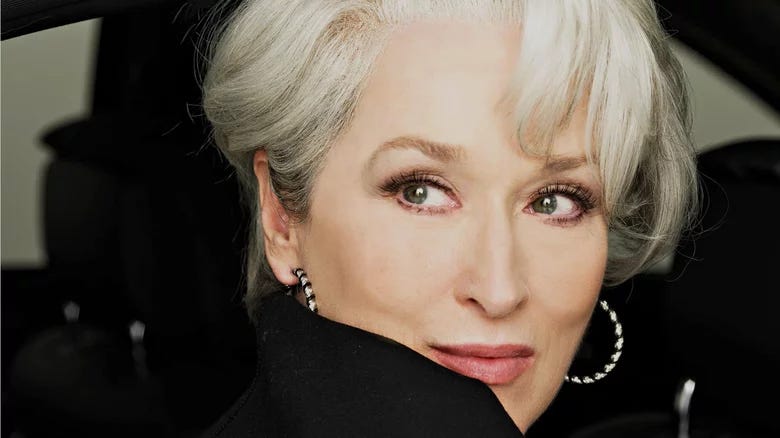
In 2006, Meryl Streep was already the most-nominated actor in Oscar history (with 2 wins and 13 nominations), a record she still holds today (3 wins, 21 nominations). She was 56 years old when they asked her to be in The Devil Wears Prada.
I don’t know how much she negotiated her other movie contracts, but from the video, it appears that asking to double her salary was a first-time occurrence and she was shocked then they said yes. This goes to show that even superstars like Meryl Streep aren’t always getting what they could be and underscores that you can and should always ask. Let’s not leave money on the table! You might not get what you ask for, but you won’t know unless you try.
Asking and not receiving
When Sheryl Sandberg’s Lean In book came out in 2013, Google organized groups of women into “Lean In Circles.” The idea was that we’d meet regularly as a group to share career challenges (and wins) and get feedback from each other and our executive sponsor. Thirteen years later, all of us have left Google (shoutout Corrie, Priscilla, Aimee, Shawna, Julia, and Jessica), but we’re still in touch. We have a regular call every six weeks, usually over video, but occasionally in person. Whomever can join dials in. Although there have been many critiques of Lean In over the years, I’m grateful that it introduced me to a great group of women.
One of the major issues with Sandberg’s book is that she argues women simply need to “ask” for what they want and not to be held back by internal barriers (like lack of confidence or fear of being “bossy”). This premise has been proven to be untrue: a 2016 Women in the Workplace study by McKinsey & Co. and LeanIn.org itself found that women were negotiating as often as men, but they were still being promoted at lower rates. Further research in 2018 showed that women actually do ask for raises and promotions at similar rates to men, but are less likely to receive them. And a major study from UC Berkeley and Vanderbilt in 2023 found that women ask for raises and promotions at similar or higher rates than men.
The narrative that “women don’t ask” can no longer be used to explain the gender pay gap. While this may have been true in the early 2000s (most notably based on research by Linda Babcock) the dozens of studies over the last decade has shown this is no longer the case. Everything points to systemic bias and the issue being how the system responds when women do ask.
The 2025 Women in the Workplace report uncovered a new shift in career advancement trends. For the first time in the study’s eleven year history, they found a measurable “ambition gap” where women are less likely than men to say they want to be promoted (80% of women vs. 86% of men). The study points out that when women receive equal career support, the gap in ambition between men and women disappears entirely.

While having strong support in the form of sponsorship and manager advocacy would undoubtedly help women, I don’t think this is the only reason why there’s a notable ambition gap. The study also found that senior-level women experience more burnout than other employees, women are often penalized for working remotely while men are not, and corporate commitment to prioritizing diversity is trending down.
It’s easy to look at all the statistics alongside my LinkedIn feed, where every week I’m seeing senior leaders hang up their tenured badges, and feel a sense of fatigue. What gives me hope is that there’s a smaller, more personal battle to be won. As a parent, my job is to ensure the next generation develops its muscle of asking for what they want early—and to hope that by the time they enter the workforce, the system will have evolved to reward that drive.
Start them young
Last week, my six-year-old told me that she helped the after-care teacher pass out Gogurt to the “big” kids (the little kids had already eaten theirs) and that she had asked the teacher if she could have another one if there were extra. The teacher said “maybe” and then gave her another when there were leftovers. My daughter was beaming when she told me she got the second snack. I told her I was really proud of her for asking.
Truly, it brought me so much joy to know that my daughter already knows, from such a young age, to ask for what she wants. Over the weekend, in preparation for watching The Devil Wears Prada 2, my kids and I watched the first movie. Afterwards, I also showed all of them the clip of Meryl sharing how she asked to double her salary.
“Good for her!” my twelve-year-old exclaimed. I couldn’t agree more. Let us always ask for what we want and cheer on those who get it. My hope for my children is that they have Meryl’s confidence now, rather than having to wait until they’re 56. It seems that my six-year-old has already realized she can double the ask.
What’s something you’ve asked for recently? Let me know in the comments! 👇
Before you go!
If you’d like to support me, any of the following really helps:
Hit the ❤️ button
Leave a comment
Share or restack
Subscribe
Thanks for being here. I appreciate you!
❤️❤️❤️ Also I love Ali Wong
Several times in my investment career, I've been told there's a minimum amount I need to invest to get into a startup or VC fund. Sometimes, it's $100k, $500k, or even $1m. What I do is introduce myself and then politely ask to invest a much smaller amount. It works very often. As you said, it never hurts to ask.