

Moonshots, moon rocks, and myths
Musings about turning fiction into reality and reality that is so fantastic it feels like fiction.

At Google, “moonshots” is a word that was thrown around a lot. X was created to be Alphabet’s “moonshot factory” and on its homepage, their mission is to “bring sci-fi ideas into reality to help solve some of the world’s hardest problems.”
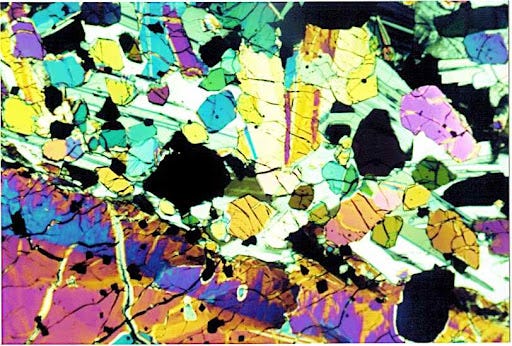
Over the weekend, I traveled to Houston, TX and learned something unexpected: moon rocks, though appearing plain gray or brown to the naked eye, are actually breathtaking rainbows when they are cut into human-hair-thin slices and viewed through a petrographic (polarized light) microscope.
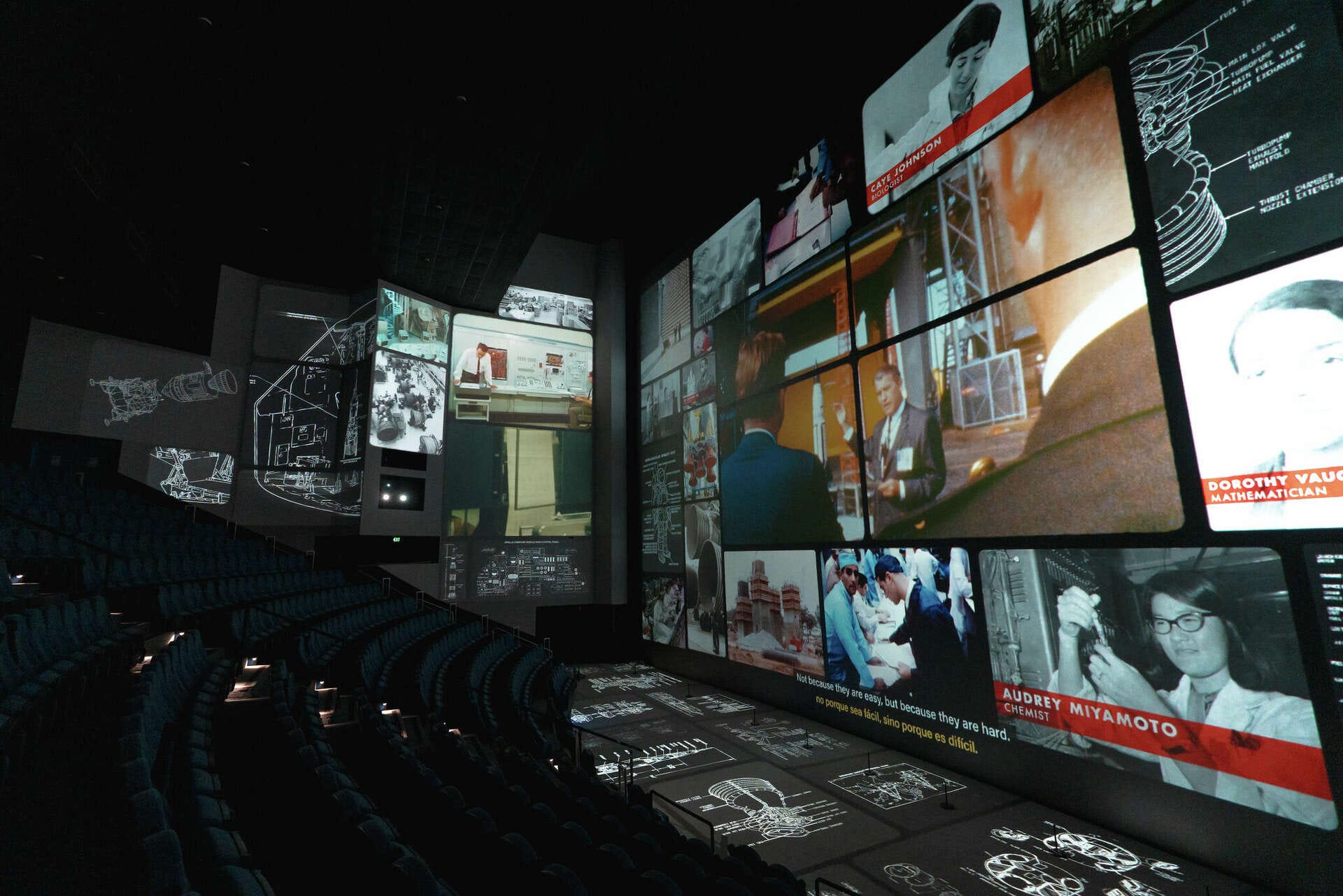
I learned this while watching The Moonwalkers: A Journey with Tom Hanks, a 50 minute immersive cinematic experience about the Apollo lunar missions. It’s a 270-degree visual feast on a five-stories tall screen that is the perfect blend of NASA footage, JFK’s speech, interviews with astronauts, and Hanks’ personal recollections of the wonder and awe he felt as a child watching the Apollo missions on television.
Earlier in the day, my family had taken a short tram ride to see the Saturn V rocket. The sheer scale of engineering on display is impressive: picture a rocket 363 feet long and 33 feet in diameter. One of the facts I read is that to move the Saturn V from the assembly building to the launch pad required a platform the size of a baseball diamond, inching forward at just one mile an hour.
Watching the movie after the experience of seeing the Saturn V rocket, I really felt this overwhelming sense of what humans can accomplish when we work together. It’s one thing to learn about the Apollo missions in a textbook and another to be standing in front of a massive artifact. The movie has a montage of some of the 400,000 people who worked on the Apollo mission and gave me more context and depth of meaning to what a “moonshot” means. I walked out of that theatre in Houston feeling more inspired than I ever felt from hearing the word used as corporate jargon.
If you have the opportunity to watch The Moonwalkers (it’s playing in other global locations), I highly recommend it. It’s epic, it’s awe-inspiring, and the whole family agreed that it was one of the highlights of our visit.
If you also think moon rocks are cool, I came across this virtual microscope, which is an interactive digital archive that allows you to zoom into actual Apollo-era samples (make sure to check the XPL box to view in color).
The Moon of Saba
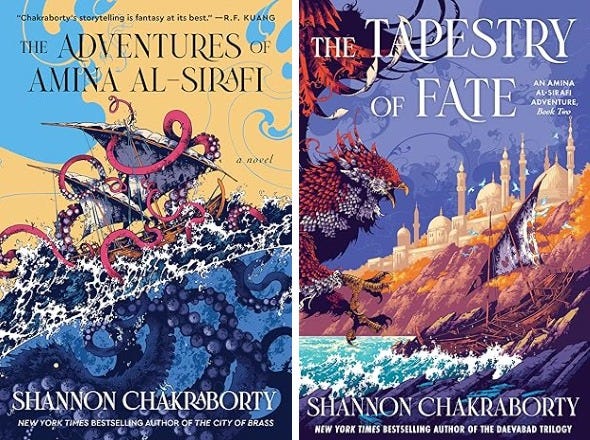
While traveling to and around Houston, I was reading The Adventures of Amina al-Sirafi. Set in a magical version of the 12th-century Indian Ocean, it is a historical fantasy novel about a retired, middle-aged mother and legendary pirate who gets pulled into a “one last job” scenario that involves supernatural threats as she tries to rescue a kidnapped girl.
It was easily the best fiction I’ve read in a while and I could not put it down, finishing the story as we were driving home from the airport. To my delight, as I was browsing around for something to cure my book hangover, I saw that the second book was released on May 12. I’ve never clicked purchase so fast.
I won’t give the story away, but it involves a magical object called the Moon of Saba. While the magic in the book is fictional, the setting is rooted in a reality that seems otherworldly. Some of the novel takes place on an island called Socotra, which I had never heard of, but is a real place in Yemen.
“Blurrin’ the lines between real and the fake.”
Lana Del Rey, National Anthem
Socotra is often called the Galápagos of the Indian Ocean because of its unique ecological diversity and high endemism. Some stats of things only found on Socotra:
37% of its vascular plant species
95% of its land snails
90% of its reptiles
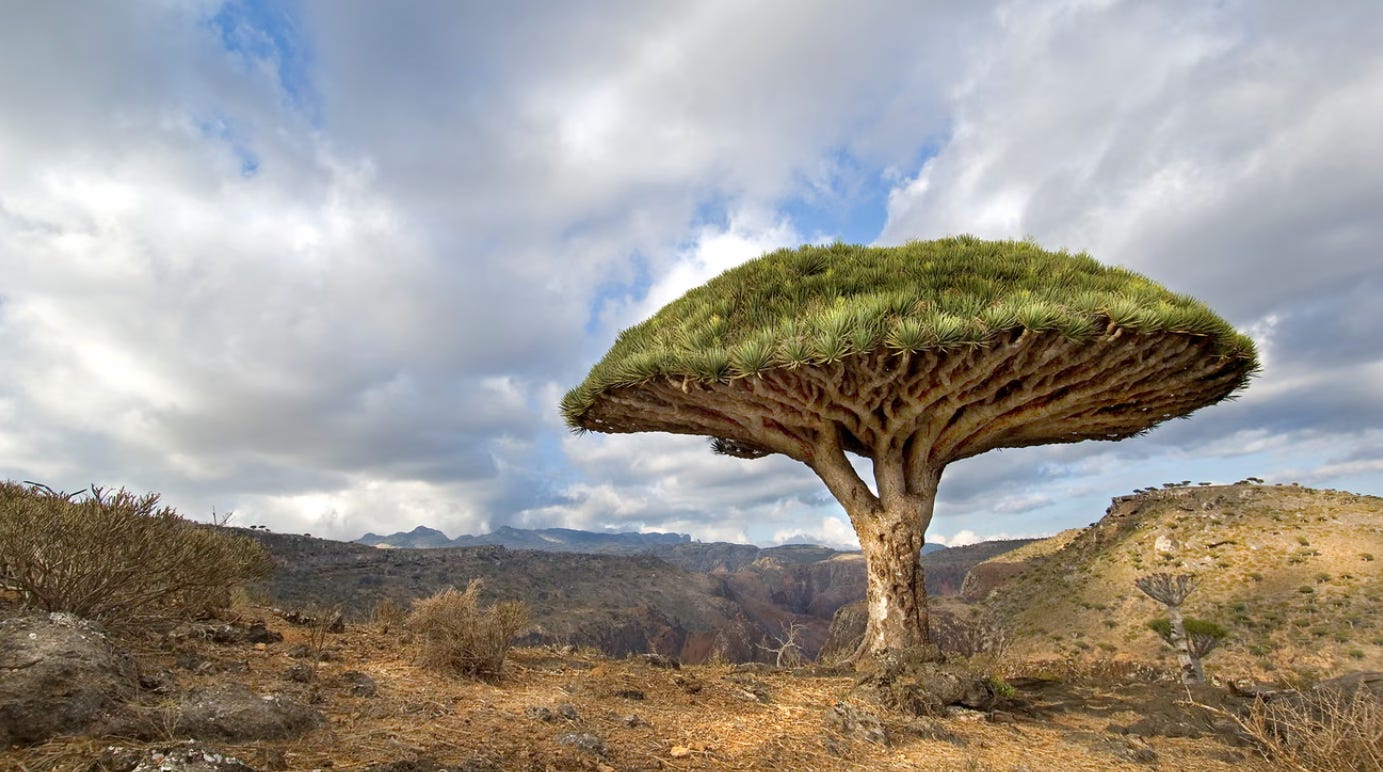
A dragon’s blood tree. Photo credit: The Guardian
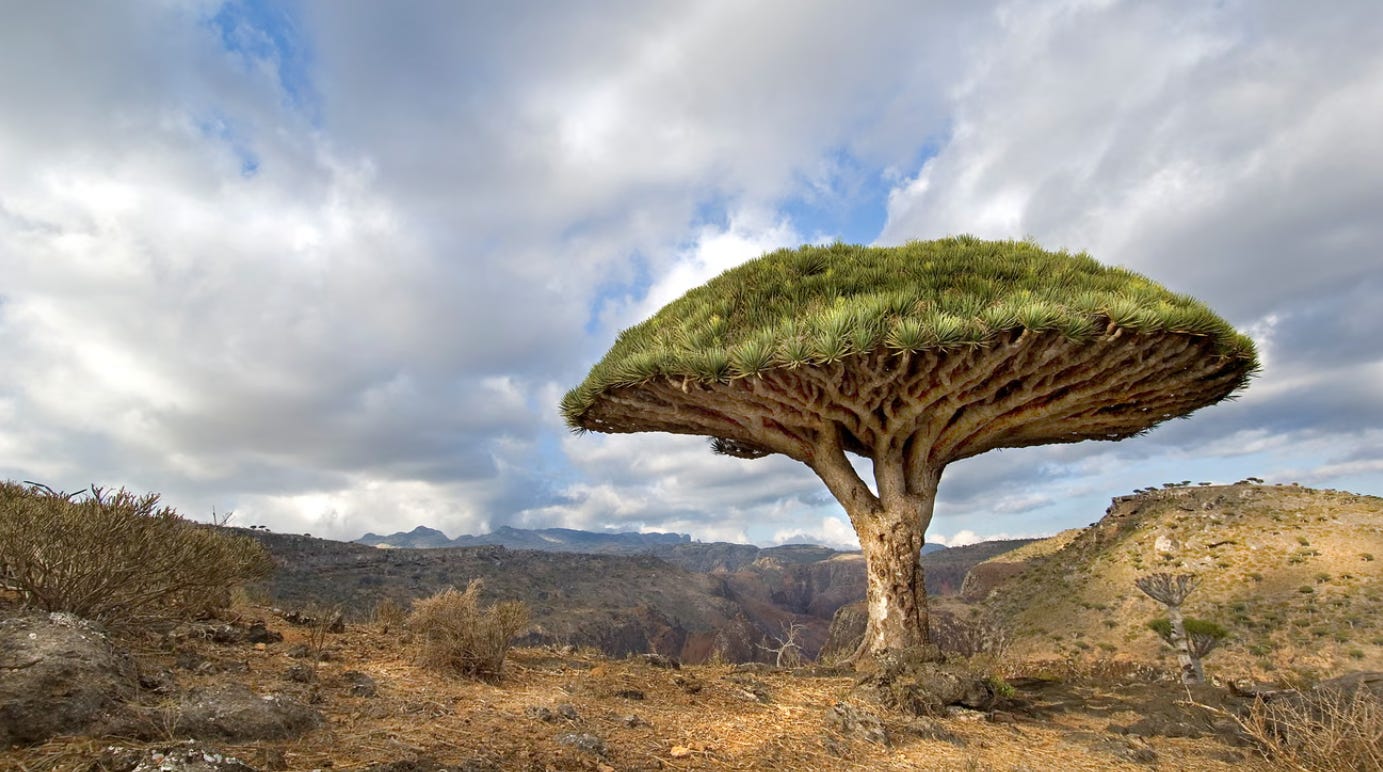
One of the plants found only on Socotra is Yemen’s national tree, the dragon’s blood tree. It looks like something from a Dr. Seuss book and “bleeds” a red color sap. In ancient Greece, Rome, and the Middle East, the sap was highly prized for use in medicine, cosmetics, and varnishes (including famous Stradivarius violin polishes). Today, it’s still used for skincare (the sap helps boost collagen production and has anti-inflammatory properties), pharmaceuticals and natural medicine (it is used in wound care and has astringent qualities), Traditional Chinese Medicine (to improve circulation and for treating cardiovascular diseases), and for crafts and woodworking (as a coloring agent). Both then and now, the resin is burned as incense for meditation and ritualistic magic.
If ever there was a tree to inspire legends, it would be the dragon’s blood tree. Based on what I could find online, there are four major legends across cultures:
Greco-Roman: According to this myth, which is part of the Twelve Labors of Hercules, Hercules was tasked with stealing golden apples from the Garden of the Hesperides. Guarding the apples was Ladon, a hundred-headed dragon that never slept. Hercules slew Ladon with a poisoned arrow and as the dragon spilled its red blood across the land, the first dragon’s blood trees sprouted. According to the myth, the tree’s twisted branches resemble the hundred necks of Ladon and cutting the tree lets you see its eternal blood, still flowing.
Arabic: Another tale is about two brothers, often identified as a dragon and an elephant, who battled to the death. The dragon bit the elephant to drink its blood, but the dying elephant fell on the dragon, crushing it. Their intermingled blood soaked the rocky earth and from this, the dragon’s blood trees grew. In historical texts, the resin harvested from the tree was referred to as cinnabar and later as dam al-akhawayn (translated to “the blood of the two brothers”) by Arab traders.
Indigenous Socotri: In local lore, the high plateaus where dragon’s blood trees grow are seen to be the domain of Jinns, or supernatural spirits. The trees were seen as living under the protection of these spirits and harvesting it required immense respect or else you would anger the island spirits.
Biblical & Islamic: Another local story believes Socotra to be the setting for the Garden of Eden and where Adam and Eve were exiled. According to this version, the very first Dragon’s Blood Tree sprouted from the exact patch where Abel’s blood was spilled by his brother Cain. Cain and Abel (Qabil and Habil in the Quran) are deeply foundational to both Christian and Islamic traditions.
Ultimately, moon rocks and dragon’s blood trees have one thing in common: they teach us the boundary between the ordinary and magical is often a matter of how close we are willing to look. Humans spin myths to explain things that astound us and we’ve built rockets that have reached what was once only possible in our imagination. Here’s to a summer of chasing our own moonshots, reading incredible books, and remembering that reality is often wilder than fiction.
Before you go!
If you’d like to support me, any of the following really helps:
Hit the ❤️ button
Leave a comment
Share or restack
Subscribe
Thanks for being here. I appreciate you!