

What's in a (domain) name?
This is the first article in a series about domains.

I spent years managing one of the world’s largest and most interesting domain portfolios, but before I did so, my knowledge of the DNS (Domain Name System) was zero. Read on for a primer on what a domain name is.
In 2012, my manager at Google asked me, “Do you know what DNS is?”
“Do Not Schedule?” I responded.
I was wrong; in this case, DNS stands for Domain Name System. DNS is like GPS for the internet. When you type in a web address (like google.com), the DNS instantly translates this into a complicated series of numbers and tells your computer to take you where you want to go.
When I managed Google/Alphabet’s corporate domains portfolio, I helped guide hundreds of people across the company on what domains to register, where to host their content, what to promote in marketing campaigns, and what domains to acquire defensively. One of my responsibilities was to train new members of the Marketing organization on how the company uses domain names. Why? Because domain names are an essential part of how any brand communicates to their customers.
Knowing how to read a domain name isn’t just for tech experts; this knowledge can help you understand if a website is legitimate and protect you from phishing scams. As a marketer, domain names are an essential part of your toolkit, but I think it benefits everyone to have basic knowledge about what a domain is and how they work.
So, what’s a domain name?
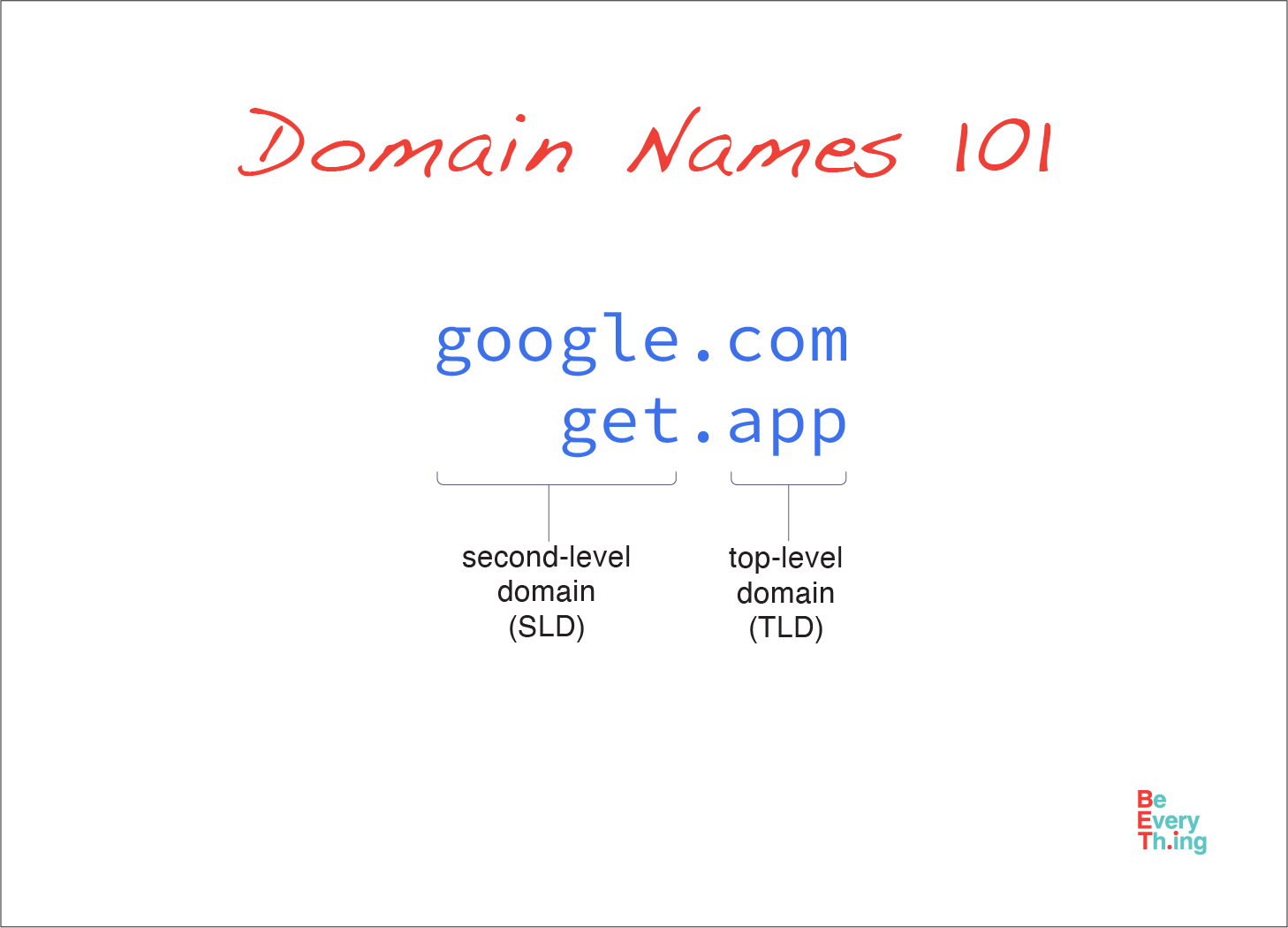
At the most basic level, a domain is an address on the internet. Instead of having to remember a complicated series of numbers (called an IP address), a domain name is an easy-to-remember address like google.com or get.app. Like a street address, every domain name is unique and no two websites have the exact same address.
The key thing to understand about a domain name is what appears to the right of the dot vs. what appears to the left of the dot. Using google.com as an example, the ‘com’ appears to the right of the dot. This is what’s called a top-level domain (TLD). There are different kinds of top-level domains, which I’ll cover in a separate post. To the left of the dot is what’s called a second-level domain. This is the part that businesses and individuals can register and own.
You can think of a top-level domain like a neighborhood and a second-level domain like a house in that neighborhood. All the homes in the .com neighborhood end with “com”, just like all the homes in a physical neighborhood have the same zip code.
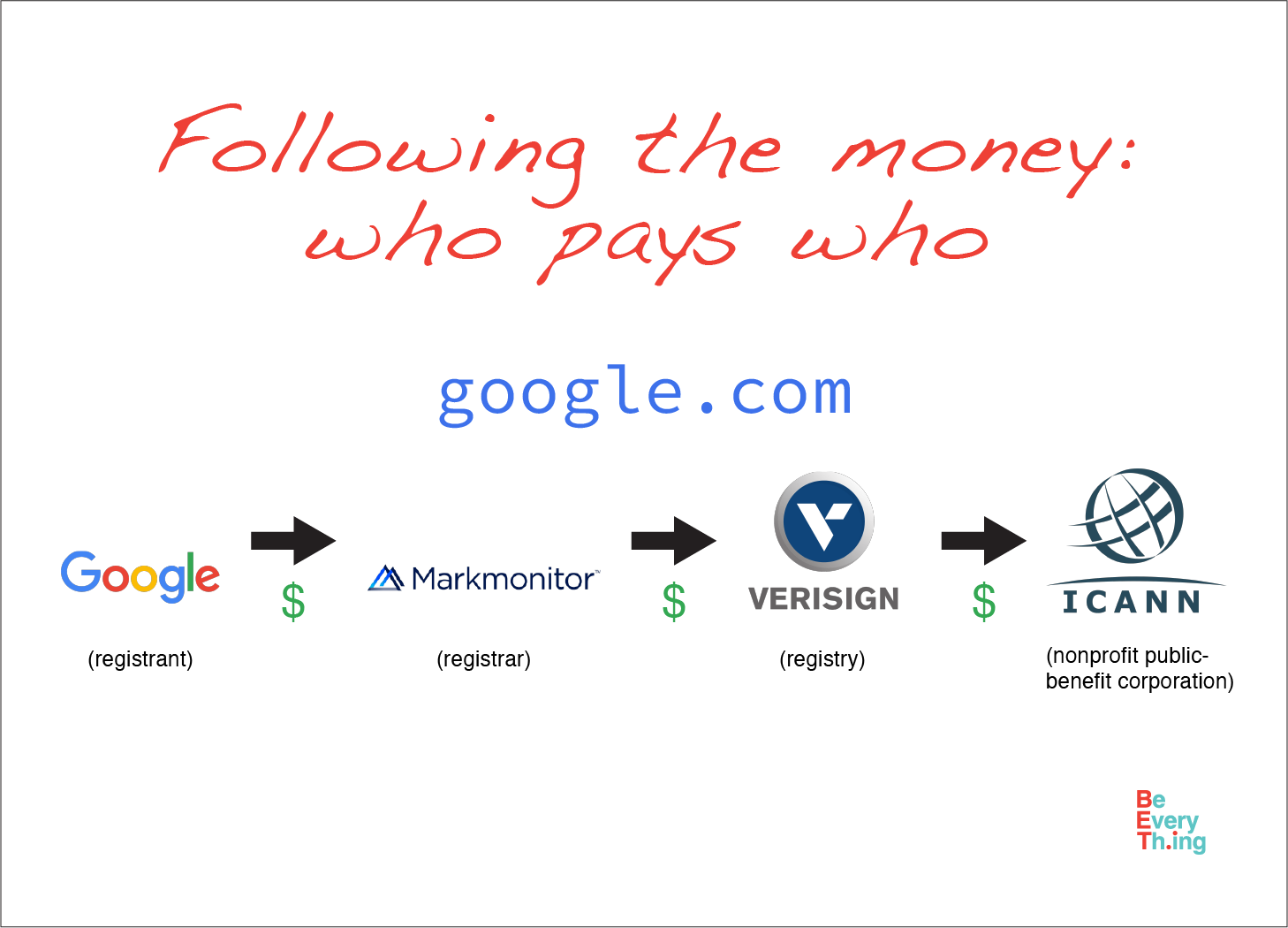
You can buy a second-level domain from many registrars, such as Porkbun, GoDaddy, Spaceship, or Dynadot (to name just a few). You pay them an annual registration fee for your domain name. As long as you continue to pay your annual fee, you can own that second-level domain name. Just like you pay a mortgage or pay rent to live in a physical location, the annual fee you pay to a domain registrar allows you to own digital real estate in the form of a domain name.
What most people don’t know is that registrars represent the retail side of the domain ecosystem. The wholesalers in this business are called registries. For example, the .com top-level domain is owned by Verisign, which is a registry. The .org top-level domain is owned by a PIR, another registry. In my role that I most recently left, I helped launch new top-level domains that Google Registry owns, with the most popular one being .app. Chances are you’ve seen or interacted with at least a couple .app domains like cash.app and shop.app. In these domains, the .app is the top-level domain and ‘cash’ and ‘shop’ are the very short and desirable second-level domains.
To add another layer, registries also have to pay annual fees to ICANN, the Internet Corporation for Assigned Names and Numbers. They are the global authority that oversees the entire system. The entire domain ecosystem—every registry and every registrar—is governed by ICANN.
Whenever I describe my job to a family member or friend, I usually preface my explanation of what I do as “very niche.” Domain names can be niche, but I don’t think they should be. If you didn’t know the basics, you now have the knowledge to understand digital real estate and navigate the web with more confidence.
Some other domain topics I plan to cover in future posts are: the difference between a domain name and a URL, the different types of top-level domains, what’s happening in 2026, and why domain hacks are so much fun.
Very informative read!
On a more technical note, DNS is a massive globablly distributed database, running on thousands of servers, by thousands of organizations... and they all need to constantly be coordinating to agree on what is correct.
It's a miracle it works at all.
There's also some interesting hacks out there where people have "misused" the DNS to exfiltrate information, or to use the DNS database as a way of storing information in novel ways.
Like, technically you can store any 255 character long string of text in a DNS TXT record... so if you just use _a lot of those_ you could store a "significant" amount of data in a globally distributed database "for free". 🤣 (I am not advocating for this, merely saying experiments have been done.)